Showing posts with label pottery. Show all posts

Friday, February 18, 2011

Local potters tour Japan in January

In January, several Pennsylvania potters were part of a two week tour of some of Japan.  Holly Van Dine and Dennis Bergevin joined a group of sociology and ceramics students which was organized at Washington and Jefferson College.  


Harada Shuroku, respected Bizen potter.

Japantrac, a tour firm from State College, organized and expertly led the trip for W & J College ceramics and sociology students.  (A few local ceramists also went along.) 

Japantrac has led Japan tours for the New York Museum of Modern Art, the Guggenheim Museum and The Japan Society and many others.  Their guides provide a depth of cross-cultural understanding and a view of Japan tailored to the interests of the travelers. 

On this trip, the group stayed in several Japanese-style hotels featuring tatami floors and guest kimonos and Japanese baths.  Ceramics visitors went to the Robert Yellin gallery in Mishima and made a trip to Bizen with Yellin as a guide.  

Robert Yellin
Robert Yellin is a leading interpreter of contemporary Japanese ceramics and runs a gallery, the Robert Yellin Yakimono Gallery in Mishima (and also available online).


Pottery from the Yellin Gallery by
Uetake Satoshi

Pottery from the Yellin Gallery by
Tim Rowan of the US.

 Pottery from the Yellin Gallery.

Pottery from the Yellin Gallery by
Takeuchi Shingo.


Pottery from the Yellin Gallery. 

Shigaraki Jar by Furutani Kazuya.

 Pottery from the Yellin Gallery by
Takeuchi Shingo.

 Pottery from the Yellin Gallery.  Ono Kotaro, white porcelain tea cups.

Bizen is considered Japan’s most popular unglazed pottery, made continuously for over 1000 years.  The clay comes from local rice paddies (high iron content) or local mountains (low iron content) and is wood fired for long periods, anywhere from 10 days to three months, since the clay will crack if the kiln temperature rises too fast.  

Japanese refer to keshiki, or the landscape of the work.  Keshiki are different effects caused by the positioning of the pot in the fire flow and fly ash.  

 Four of these effects are called:  yohen, or highly prized firing mutations; goma, a sesame seed tone from the ash; hidasuki, a fire cord pattern; and sangiri, a charcoal tone. 


 Bizen pottery.

 Bizen pottery.

 Bizen pottery.

 Bizen pottery.

 Bizen pottery.

Robert Yellin offered us this Sixth century BC poem as very much in the spirit of Zen and a yakishime (woodfire) pot: 

Pots are made out of clay
But the hollow space in them makes the essence of the pot
And the essence comes from an intangible something
In the spirit of the potter
Which he is able to blend into all his knowledge of the throwing,
The glazing, and the firing
So that every piece from his hand is as much his own signature and his heartbeat
Only then will the pot be good, that is, alive
And the more  highly developed a potter is as a human being, the better his pot
For there is no real beauty without character.

 Most potters love food so Holly has provided us with a visual sampling.

 The Reverend's noodles.

Eel Dinner.

Baby Sardine Dinner.

 Prawn Dinner.

At the Sushi-go-round. Holly and Dennis on left.

 At the Sushi-go-round.
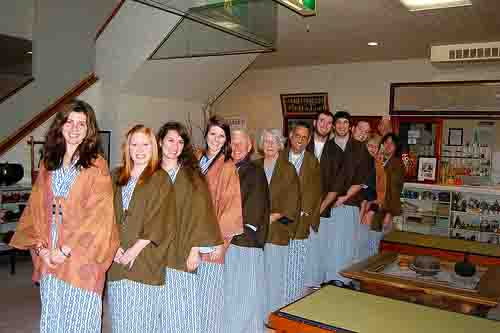
 Dressing up for dinner.

 From the Noodle Shop.

Japanese Bakery.

Yogi Dennis.

Calligrapher.

 Calligrapher.

Dennis meets the wall.

  Holly's room at the Buddhist Complex.

For more information on future tours, you can reach Japantrac at Jonathan Phillippi  

John Britt video of making a pho bowl.


John Britt video of making a pho bowl.  John is the blog master of the NC Clay Club blog at:

John Britt video of making a v-shaped bowl.


John Britt shows how to make a v-shaped bowl.

John is the blog master for the NC Clay Club blog

John Britt video of throwing tumblers.


John Britt, potter who does the NC Clay Club blog, demonstrates throwing a tumbler in a unique way.

Studio Rental Space - BrickPitt Ceramic Studio

Studio Rental Space - BrickPitt Ceramic Studio

Heather Connolly in her studio.

http://www.brickpittceramicstudio.com


Heather has established a clay studio in the Penn Hills section of Pittsburgh and is offering rental space to potters, along with classes and open studio time.

To discuss rental, contact Heather at:
brickpittstudio@gmail.com
 or call
412-727-1329

 Studio is located at
102 Purity Road. Pittsburgh, Pa. 15235

Heather has a group of potter's wheels, kiln, shelving, ect.


BrickPitt Ceramic Studio is outfitted with two large work tables, a large wedging table and glaze table as well as built-in shelving for ample storage space and 24 hour access for renters.

Future plans include acquiring a slab roller, extruder, spray booth and additional electric kiln.


Additional information is at the website:
http://www.brickpittceramicstudio.com 

If you are a potter in the area, make yourself known to her.

Welcome and good luck.

Monday, January 10, 2011

Profile: Karen Howell

Profile:  Karen Howell (Karen is now retired)

Fredasaurus
This was a commission that Karen did as a tribute to Fred Rogers.  In fact, there are similarities in personalities of Fred and Karen:  both projected a strong gentleness that was backed by a seriousness of purpose that was/is maintained over a lifetime.

Karen earned an undergraduate degree in art education at IUP during the seventies and taught in public school in the early part of her adult life.  She also went on to earn an MFA in ceramics from IUP.  Upon being laid off during a cutback at her school district, Karen set up a studio in Trafford, PA and has been an independent ceramic artist since then.  

While proficient at throwing porcelain, Karen has evolved into a tile artist and draws heavily on her drawing skills and understanding of ceramics to develop her unique look. 

Fireplace commission in progress.  (Apologize for the poor photo.)


Molds on shelving.

 
More molds - Karen has literally hundreds of molds produced over the years.
 
Bisque with mold.   

Originals are produced on moist slab rolled tiles.  Karen utilizes her considerable drawing skills to incise lines in the moist clay which helps control the flow of the glaze when molten.


Molds are filled via a slip casting process.  Karen buys a dry porcelain mix from Standard Ceramic and blunges it in the Slip-O-Matic.  She then fills the dispensing unit (square take to the left).  About half of the 150 lb. mix in the Slip-O-Matic fills the dispensing unit.


From there Karen uses a pitcher to fill the molds lined up on a nearby table.  Poured pieces dry for a day and are then released and trimmed.  Slip cast tiles are then placed on a sheet of 5/8" drywall board cut slightly smaller than the wooden ware boards on her drying carts.

Flat slab pieces are slowly dried between two sheets of 5/8" drywall board to prevent warping.  She uses a Brent slab roller.  She has sold her ram press which was used when her business did a lot of wholesaling.  At one point she had four employees now she works alone.

The production side contains three 10 cu ft Crusader Cone 10 kilns, although she fires to Cone 6.  The kilns are connected to a Fire Right controller, which has limited ramp and cool-down capabilities but helps in managing the firings.

Over the years, Karen has done a lot of her own building and repair work, crediting her father with helping to build a skill set.  He also built a number of pieces of equipment including a potter’s wheel, although she now prefers the Brent wheel.
 
Cat tile.  Notice the mice in the corners.  Her drawing skills allow her to bring life to animals she draws (in this case the cat not the mice).

Crow tile.  Good example of incised lines controlling the glaze flow.


More crows (notice the eyes).


Bird tile.


 Kitchen back splash.  While Karen does commissions, most of her sales are single tiles that are sold at art fairs and from her website.


Landscape over fireplace.


Another landscape.


Karen belongs to the Pennsylvania Guild of Craftsmen and sells her work at art fairs in the Northeast US.


Contact Karen Howell at the following:  (She's friendly).

(Karen is now retired)

Karen Howell Porcelain
PO Box 7
208 Fifth Street
Trafford, PA 15085

By phone:
412.856.8933 (between 10 a.m. and 5 p.m.EST)

Email:  Howellporc@aol.com

www.karenhowell.com 


Profile: West Virginia University, College of Creative Arts, Ceramics Production, Studio and Gallery


West Virginia University, College of Creative Arts, 
Ceramics Production, Studio and Gallery


The Production Studio as part of the Ceramic Arts Program was conceived by Bob Anderson, who spent 30 years as the head of the WVU ceramic studios.  The Production Studio is currently housed in a 2,800 sq ft space in Ridgeview Business Park, which is near the WVU campus.  The space is broken down in the following way: 
2800 sq.ft. total space, 2000 sq.ft. Studio, 750 sq.ft. Gallery


Bob's idea was to provide students going through the undergraduate program with an education that included design and production experiences that would better equip them upon graduation.  He and many others worked on the idea for a number of years and secured funding through the University, foundations, and a Congressional earmark of several hundred thousand dollars.

Undergraduate ceramic students can take three semesters of experience/classes at the Studio.  There they learn a variety of design and production techniques for producing work that will be consumed by the public.  

The Studio is run by Chris Brown with Shoji Satake as the director/faculty of the Ceramics department and Robert "Boomer" Moore as faculty and Chris’ immediate supervisor. Bob Anderson is in the process of retiring and heads up the China Program. He also acts as a mentor on this project.

The WVU Ceramics Area has offered a comprehensive summer study program at Jingdezhen since 1995, and in 2004, it expanded the partnership to include a fall semester program that provides advanced undergraduate, graduate and professional-level studies in ceramics, including basic language, culture and Chinese ceramic art history. Also as part of the program, WVU maintains collaborative studio space in Jingdezhen of more than 16,000 square feet available to American and Chinese students and faculty.


The Production Studio consists of a gallery, small office, and large production space that includes equipment, supplies, and shelving.  Students receive an orientation experience that gives them a foundation to enable them to receive compensation for the work that they do there.  

The work is sold and the proceeds are used to help fund the Center.  I believe the Studio's goal is to be financially self- sufficient.

Soldner Pro Mixer.

The Studio uses a Cone 10 clay body that is part stoneware and part porcelain with 10% pyrophyllite to mitigate cracking and shrinkage.  
 
Standard Ceramics in Pittsburgh dry mixes and bags a custom cone 10 clay body that Chris has developed over a number of years. The grog is added when mixing to allow flexibility with that part of the recipe.


Venco Pugmill and jiggering templates.

Chris likes the Venco since the barrel splits apart for easy clean out.  This is important because the ram press uses stiffer clay and the jiggering machine uses a softer clay.  Since the soft clay will not push the stiff clay out of the mill, it has to be cleaned out by hand.

The jiggering templates are made from popular wood and zinc coated plates from the art department's press shop.  Often times a piece is thrown and cut in half to trace the lines for the template for the inside of the jiggered pot.


Ram Press.

The bottom unit is connected to a hydraulic cylinder powered by a pump.  Steel cased, plaster molds are bolted to the top and bottom with each also connected to a air compressor via a valve welded to each part.  

The valve is connected to a porous fiber tube which is supported by chicken wire located one inch from the exposed mold surface.  After the clay is pressed between the top and bottom molds, air is first injected into the bottom and the mold is retracted, leaving the clay molding suspended to the top.  

A ware board is inserted under the piece and the air is injected into the top mold for release.  Depending on the piece being produced, they can quickly fill up their ware carts with more production available than space to hold the work.

Ram Press mold.

Molds are quite heavy and require some level of technical expertise to correctly fashion.  They build their own molds in-house.

Student jiggering a pot.


The jiggering machine came from Homer Laughlin China.  A steel bucket holds the mold and spins.  A soft, deaired clay ball is dropped into the bottom of the plaster mold and the operator uses his hand and the jiggering template to form the clay piece.  Some skill/training is involved especially in forming the rim, which often needs trimmed when leather hard.


Production molds create a form with flexibility designed in to allow the pieces to be trimmed and altered. All jiggered forms are trimmed.   

Chris views this as a combination process. The molds eliminate the need for about 3/4 of the clay a hand thrown piece. Using extruded forms to pull handles reduces the number of variables. Many of the forms are used to create more than one product. A salad bowl, batter bowl, colander, and butter dish lid may all be made from of the same mold.

Once inserted on a ware cart, the piece can be removed the same day or next depending on the drying conditions.

Chris helping a student adjust the template for a new setup.


Student trimming a jiggered piece.  He will later add an extruded and then pulled handle.

Another student trimming a piece.  They often use rubber forms to hold the ware since there is uniformity in each design.  The Studio works to teach attention to design detail so that forms are aesthetically pleasing.  Forms are constantly tweaked to improve design quality.

Electric kiln and spray booth.


After drying, pieces are bisque firing in an Olympic electric kiln and then glazed.

Gas kiln.


Chris constructed the 104 cubic ft. Kiln and two forced air burners that produce 1.5 million BTUs on location.  He consulted with Jerry Wagner to get a bid on a 40 cubic ft. fiber kiln that Jerry builds and about I.F.B. 

The University sheet metal shop manufactured the hood, and the University’s engineers help resolve issues with ventilation. The kiln has approximately 65 cubic ft. of stacking space and can be fired to cone 10 in as few as 9 hours. He usually soaks for about an hour to finish off in about 10-11 hours.  

 He used a 10 inch high temperate blower that moves 1500 cfm to vent and cool the exhaust gases. He purchased it from Grainger, and it was made to service large heating systems that produce over a million BTUs. It can be used with up to a 14 inch exhaust pipe. He decided to use 2800 degree brick in the firebox after some of their older kilns developed issues in that area.
 
  Chris reports that the kiln fires easily especially with the use of an oxygen analyzer and results temperature wise are fairly close throughout the kiln,

Kiln venting system.


A squirrel cage blower pushes air down a U-shaped length of pipe to cool the exhaust gas.  The offset helps to create turbulence that promotes draw.

Bisque load.

Glaze load.

Glaze load detail.

The Gallery.


The following are pictures of work in the gallery in the front of the building.  Most of the work has been produced at the Studio and is for sale.
 
The majority of the work is sold at two major sales in the lobby of the College of Creative Arts. These sales coincide with the last day of class in the fall and spring semester. Also, they have work in a number of retail galleries and shops in West Virginia. They are looking to expand their retail market as they grow.

 Detail of some production pieces.


Porcelain piece from their China program.


Chris Brown can be contacted by:
Email:  cbrown@mail.wvu.edu
Phone:  304 293-2964


West Virginia University
College of Creative Arts
Ceramics Production
Studio and Gallery
200 Frederick Lane, Suite 3
Morgantown, WV 26508